Screening for Autism: Tools, Ages, and Next Steps for Children and Adults
Screening for autism is often the first structured step when a parent, caregiver, teen, or adult notices patterns that may be related to autism spectrum disorder. A screening tool can organize observations, highlight areas worth discussing, and support an informed referral, but it is not the same as a full clinical assessment. For adults who are also wondering about social masking or camouflaging, a privacy-conscious CAT-Q self-reflection tool can add useful context alongside autism screening. This guide explains common screening ages, tools for children and adults, what results can and cannot tell you, and how to prepare for a calm next conversation with a qualified professional.

Screening Is a Starting Point, Not a Formal Autism Evaluation
Autism screening is a brief process designed to identify whether someone may benefit from a more complete assessment. It usually uses questionnaires, checklists, interviews, observation, or a mix of these methods. For young children, screening often happens in pediatric primary care. For teens and adults, it may begin with a self-report questionnaire, a primary care conversation, a therapist referral, or a specialist intake form.
The key point is simple: screening raises questions; it does not settle them. A positive result means the person may need a deeper review of developmental history, communication patterns, sensory experiences, restricted or repetitive behaviors, daily functioning, and possible co-occurring conditions. A low score also does not erase lived concerns, especially when traits are subtle, masked, or context-dependent.
That distinction matters because autism is not found through a blood test or one quick online quiz. A careful autism evaluation looks across time and settings. It often includes clinical judgment, standardized tools, developmental history, and information from the person or people who know them well. Screening is useful because it can make that next step easier to justify and easier to discuss.
Autism Screening Ages for Toddlers and Children
In the United States, developmental screening is commonly discussed around regular well-child visits. The American Academy of Pediatrics recommends developmental and behavioral screening at 9, 18, and 30 months, with autism-specific screening at 18 and 24 months. Additional screening may be appropriate when a child has a sibling with autism, was born preterm, has developmental concerns, or shows signs that caregivers or clinicians want to understand better.
Why 18 and 24 months matter
Autism-related differences can sometimes be visible by 18 months or earlier. Around this age, many screeners look at early social communication, response to name, gestures, shared attention, pretend play, imitation, repetitive behaviors, sensory responses, and flexibility around routines. The 24-month visit gives clinicians and caregivers another chance to review development because some patterns become clearer with time.
Screening at these ages is not about labeling a child too quickly. It is about noticing whether support, early intervention, speech-language evaluation, occupational therapy, hearing checks, or a fuller developmental assessment may be useful. Earlier support can help families respond to the child in a more informed way.

Screening beyond toddlerhood
Autism screening can still be useful for preschoolers, school-age children, and teens. Some children meet early milestones but later struggle with peer interaction, sensory overload, transitions, classroom demands, literal communication, or intense interests that interfere with daily life. Others may be bright, verbal, and socially motivated, yet become exhausted by the effort required to keep up.
For older children and teens, screeners often rely on parent, teacher, or self-report information. They may ask about friendships, conversation style, routines, sensory sensitivities, emotional regulation, restricted interests, and school functioning. If the child has learned to copy social behavior, adults may need to look beyond surface politeness and ask what the effort costs.
Common Autism Screening Tools and What They Measure
Different tools serve different purposes. Some are designed for toddlers, some for school-age children, and some for adolescents or adults. A useful screening tool should fit the person's age, language level, support needs, setting, and reason for referral.
The Modified Checklist for Autism in Toddlers, Revised with Follow-Up, often called M-CHAT-R/F, is a widely used parent questionnaire for toddlers around 16 to 30 months. It asks about early social communication and behavior. The follow-up interview is important because it can reduce misunderstandings and help clinicians decide whether a referral is needed.
General developmental screeners, such as broad parent questionnaires used in pediatric care, may look beyond autism to language, motor, cognitive, and adaptive skills. These are helpful because a child may need support for more than one developmental area.
Tools such as the Screening Tool for Autism in Toddlers and Young Children use interactive activities to observe play, communication, and imitation. For school-age children and teens, tools such as the Autism Spectrum Screening Questionnaire can gather parent or teacher observations about social and behavioral patterns.
For adults, common screening questionnaires may include brief tools such as the AQ-10 or longer self-report measures used in clinical and research contexts. These tools can help decide whether a comprehensive autism assessment is worth pursuing. CAT-Q.org's adult camouflaging questionnaire is different from an autism screener: it focuses on autistic camouflaging traits, such as masking, compensation, and assimilation. That can be especially relevant when an adult's outward behavior looks more typical than their internal effort feels.

No tool is perfect. A screener can miss people who camouflage, women and gender-diverse people whose traits were misunderstood, people from underrepresented communities, and adults who have spent years building social scripts. It can also flag concerns that turn out to be better explained by anxiety, ADHD, trauma, language differences, hearing differences, or other factors. Good screening leads to better questions, not instant certainty.
Screening for Autism in Adults
Adult screening for autism often begins because something finally makes a long-standing pattern visible. A person may notice lifelong social fatigue, sensory overload, difficulty with unwritten rules, intense interests, shutdowns after social demands, or a feeling of performing in everyday interactions. Some adults start looking after their child is assessed. Others arrive through burnout, relationship stress, workplace strain, or conversations with autistic friends.
Adult screening is different from toddler screening because clinicians cannot rely only on early developmental observation. They may ask about childhood history, school reports, family memories, current relationships, work or study experiences, sensory patterns, repetitive behaviors, and mental health history. For some adults, records are incomplete or family input is unavailable. That does not make the process pointless, but it can make preparation more important.
If you are searching for autism screening for adults near you, common starting points include a primary care clinician, psychologist, psychiatrist, neuropsychologist, developmental specialist, university clinic, community mental health center, or insurance provider directory. In some locations, autism assessment services have long waitlists. While waiting, it can help to keep notes about examples, triggers, strengths, support needs, and situations where camouflaging becomes exhausting.
Adults should be cautious with free online autism tests. They can be a useful first reflection, but they vary widely in quality. A good online tool should clearly state its purpose, age range, limitations, privacy practices, and next-step guidance. It should not promise certainty or pressure you into a paid result. If a result feels meaningful, bring it to a professional conversation as one piece of information.

What Screening Results Can and Cannot Tell You
A screening result can suggest whether autism-related traits are worth further review. It can help you describe concerns more clearly, track examples, and decide whether to ask for a referral. For parents, it can support a conversation about early intervention or developmental services. For adults, it can help organize years of scattered experiences into patterns that are easier to explain.
A screening result cannot provide a complete picture by itself. It cannot capture every cultural, family, school, workplace, gender, sensory, or mental health context. It also cannot tell whether support needs are caused by autism, another condition, environmental mismatch, or several overlapping factors. That is why the next step is often a fuller assessment, not a single yes-or-no answer.
It is also worth understanding false positives and false negatives. A false positive means a tool flags concern, but a fuller evaluation points elsewhere. A false negative means a tool does not flag concern even though autism-related traits may still be present. Camouflaging can contribute to false negatives because the person may have learned to suppress visible traits, force eye contact, copy social scripts, or hide distress until they are alone.
The most useful mindset is practical rather than fearful: What did the screener highlight? Which examples fit daily life? What support would help now, regardless of the final clinical wording? Which questions should be brought to a professional?
How to Prepare for a Professional Conversation
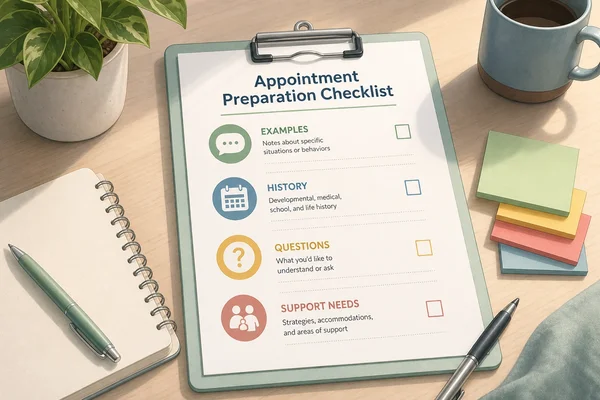
Preparation makes screening results more useful. You do not need a perfect life history. You need concrete examples that show patterns across time, settings, and daily functioning.
Start with development and communication. For a child, note language milestones, gestures, response to name, play style, social interest, sensory reactions, routines, sleep, feeding, and transitions. For a teen or adult, note early memories, school experiences, friendships, work or study demands, sensory overload, social recovery time, repetitive behaviors, focused interests, and shutdown or meltdown patterns.
Next, separate traits from impact. Instead of saying "social situations are hard," describe what happens: losing track of conversation, scripting responses, missing indirect hints, needing hours to recover, avoiding group settings, or feeling physically drained after appearing fine. Impact helps clinicians understand support needs.
Bring screening results if you have them, but do not rely on scores alone. Write down what surprised you, what felt accurate, what felt inaccurate, and what the tool did not ask. If you are preparing for a child, include observations from teachers or caregivers when possible. If you are preparing as an adult, include examples from home, work, relationships, and sensory environments.
Finally, decide what you want from the appointment. You might want a referral, school support, workplace accommodations, therapy guidance, sensory strategies, or a clearer explanation of lifelong experiences. A low-pressure goal keeps the conversation focused.
A Calm Way to Use Screening for Self-Understanding
Screening for autism can feel emotionally loaded, especially for adults who have spent years wondering why social life feels effortful. Try to treat screening as a map, not a verdict. A map does not tell you who you are; it helps you decide where to look next.
For many adults, autism screening and camouflaging reflection belong together. A person may score below a threshold on one screener because they have learned to compensate, yet still experience intense masking fatigue. Exploring a guided CAT-Q reflection can help name those camouflaging patterns before or after a broader autism screening conversation. It is not a substitute for clinical care, but it may make your examples clearer and your self-understanding gentler.
Whether you are supporting a child, a teen, or yourself, the healthiest next step is usually specific and calm: collect examples, choose an age-appropriate tool, discuss concerns with a qualified professional when needed, and seek practical support for the challenges already affecting daily life.
FAQ
What is the screening test for autism?
There is no single screening test for autism that fits every age and situation. Toddlers may be screened with tools such as the M-CHAT-R/F, while school-age children, teens, and adults may use different questionnaires or interviews. Screening tools estimate whether a fuller autism assessment may be useful. They do not replace clinical judgment or a comprehensive evaluation.
What are the 5 main symptoms of autism?
Autism is usually understood through two broad areas: social communication differences and restricted or repetitive patterns of behavior, interests, or sensory responses. People often ask for "5 symptoms," but autism does not work like a simple checklist. Common signs can include differences in back-and-forth conversation, nonverbal communication, relationships, routines, sensory processing, and focused interests.
What is the biggest red flag for autism?
There is no single red flag that applies to everyone. In young children, concerns such as not responding to name, limited gestures, limited shared attention, delayed speech, loss of skills, or repetitive behaviors should be discussed with a pediatric clinician. In adults, long-term social exhaustion, sensory overload, rigid routines, or intense masking may be worth exploring, especially when they affect daily life.
What age should autism screening happen?
Autism-specific screening is commonly recommended at 18 and 24 months during well-child visits, with broader developmental screening at 9, 18, and 30 months. Screening can also happen later if concerns appear in preschool, school years, adolescence, or adulthood.
Can adults use online autism screening?
Adults can use online screening as a first reflection, but results should be treated carefully. Look for tools that explain their purpose, age range, privacy practices, and limitations. If the result feels relevant or your daily life is affected, consider discussing it with a qualified professional.
Where can adults get screened for autism?
Adults can start with a primary care clinician, psychologist, psychiatrist, neuropsychologist, autism assessment clinic, university clinic, community mental health service, or insurance directory. Availability varies by location. It helps to ask whether the provider has experience with adult autism, camouflaging, gender-diverse presentations, and co-occurring conditions.
What is mild autism called?
Many people use "mild autism" casually, but it can be misleading because outward traits may look mild while internal effort or support needs are significant. Clinically, some systems use support levels, and older terms such as Asperger syndrome are no longer used as formal terms in many current diagnostic frameworks. It is usually better to describe specific strengths, needs, and contexts.
Is a free autism test enough?
A free autism test can be a useful starting point, but it is not enough for a formal answer. Use it to organize questions, notice patterns, and prepare examples. If you are concerned about a child, teen, or yourself, a professional conversation can help clarify what support or further assessment makes sense.