Autism Test Name: What Autism Assessments Are Called
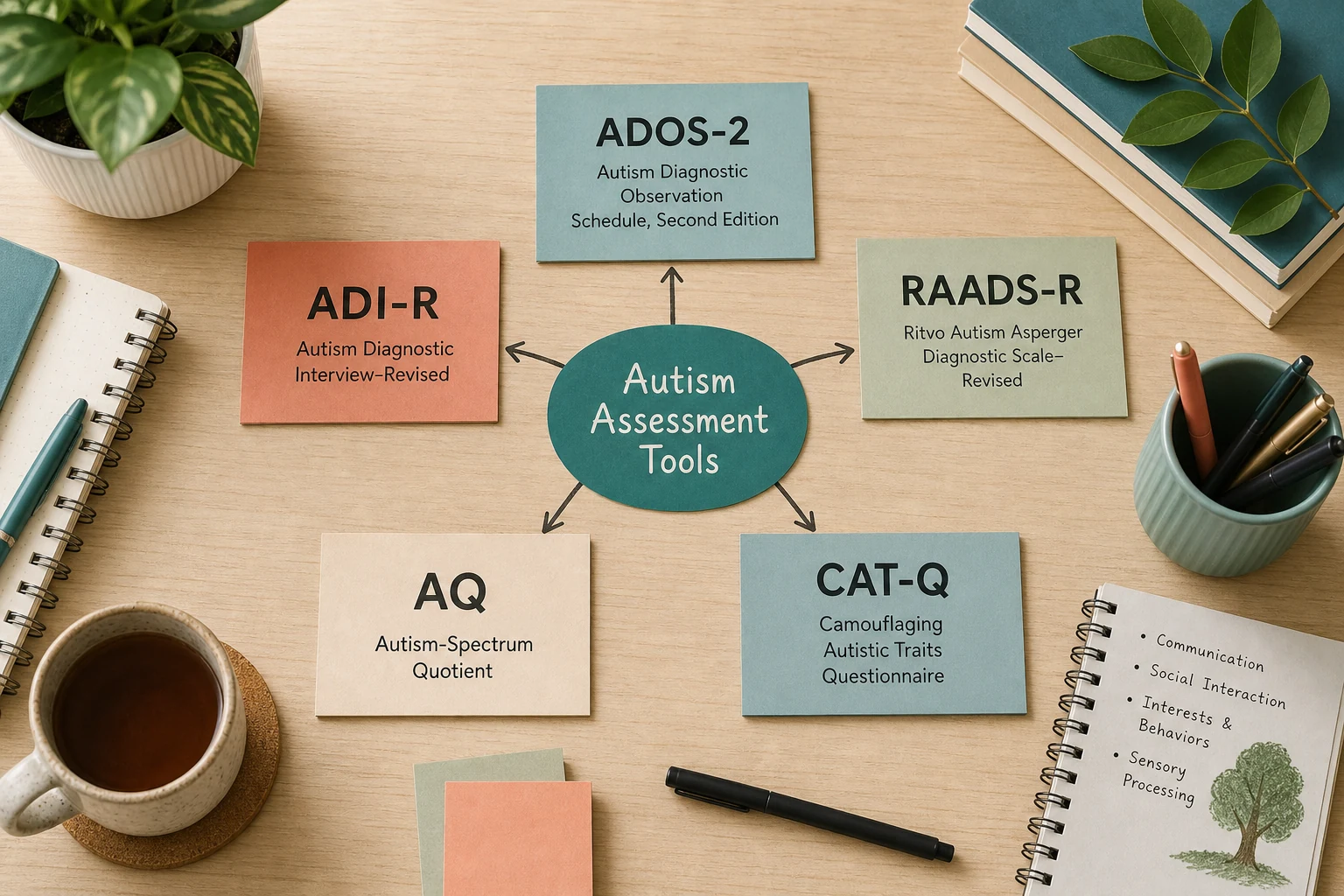
If you are searching for an autism test name, you are probably trying to translate a confusing set of acronyms into something practical: ADOS-2, ADI-R, RAADS-R, AQ, CAT-Q, and sometimes the broader phrase ASD test. The short answer is that there is no single test that covers every purpose. Some tools support a formal autism assessment, while others are self-report screeners that help adults organize questions before speaking with a qualified professional. For adults exploring social masking or camouflaging, an autistic camouflaging self-reflection tool can be a gentle starting point, as long as it is treated as information rather than a final answer.
The Short Answer: Common Autism Test Names
The name of a test for autism depends on the setting. In clinical assessment, people often hear about the Autism Diagnostic Observation Schedule, Second Edition, usually shortened to ADOS-2. They may also hear about the Autism Diagnostic Interview-Revised, or ADI-R, which gathers developmental and behavioral history through a structured interview. These tools are usually used by trained clinicians as part of a broader assessment process, alongside history, observation, professional judgment, and sometimes reports from family members or other people who know the person well.
In self-report or screening contexts, the names are different. Adult screeners may include the Autism-Spectrum Quotient, often called AQ, the Ritvo Autism Asperger Diagnostic Scale-Revised, usually called RAADS-R, and the Camouflaging Autistic Traits Questionnaire, known as CAT-Q. These questionnaires can highlight patterns worth discussing, but they are not the same as a full clinical evaluation. A high or low score should be read as a conversation starter, not as a final identity label or medical conclusion.
So, if someone asks, "What is the autism test called?" the safest answer is: the best-known clinical observation tool is ADOS-2, but autism assessment usually uses more than one source of information. For adult self-reflection, RAADS-R, AQ, and CAT-Q are common names you may see online.
ADOS-2: The Name Many People Mean
ADOS-2 stands for Autism Diagnostic Observation Schedule, Second Edition. It is often discussed because it gives clinicians a structured way to observe social communication, interaction, play or imagination when relevant, and restricted or repetitive behaviors. The person is not simply filling in a quiz. Instead, the clinician sets up activities and conversations that make certain behaviors easier to observe in a consistent way.
The important nuance is that ADOS-2 is a tool within an assessment, not the whole assessment by itself. A careful professional process also considers developmental history, current functioning, sensory experiences, mental health context, language, culture, and support needs. This matters because autism can overlap with ADHD, anxiety, trauma history, learning differences, and social experiences shaped by gender, race, or LGBTQ+ identity.
For adults who have spent years masking, a structured observation may not capture everything that happens internally. Someone might appear socially fluent while using intense effort, scripts, eye-contact rules, or post-event analysis. That is one reason self-report tools about camouflaging can be useful as preparation. They can give language to experiences that are not always obvious from the outside.
ADI-R and Developmental History
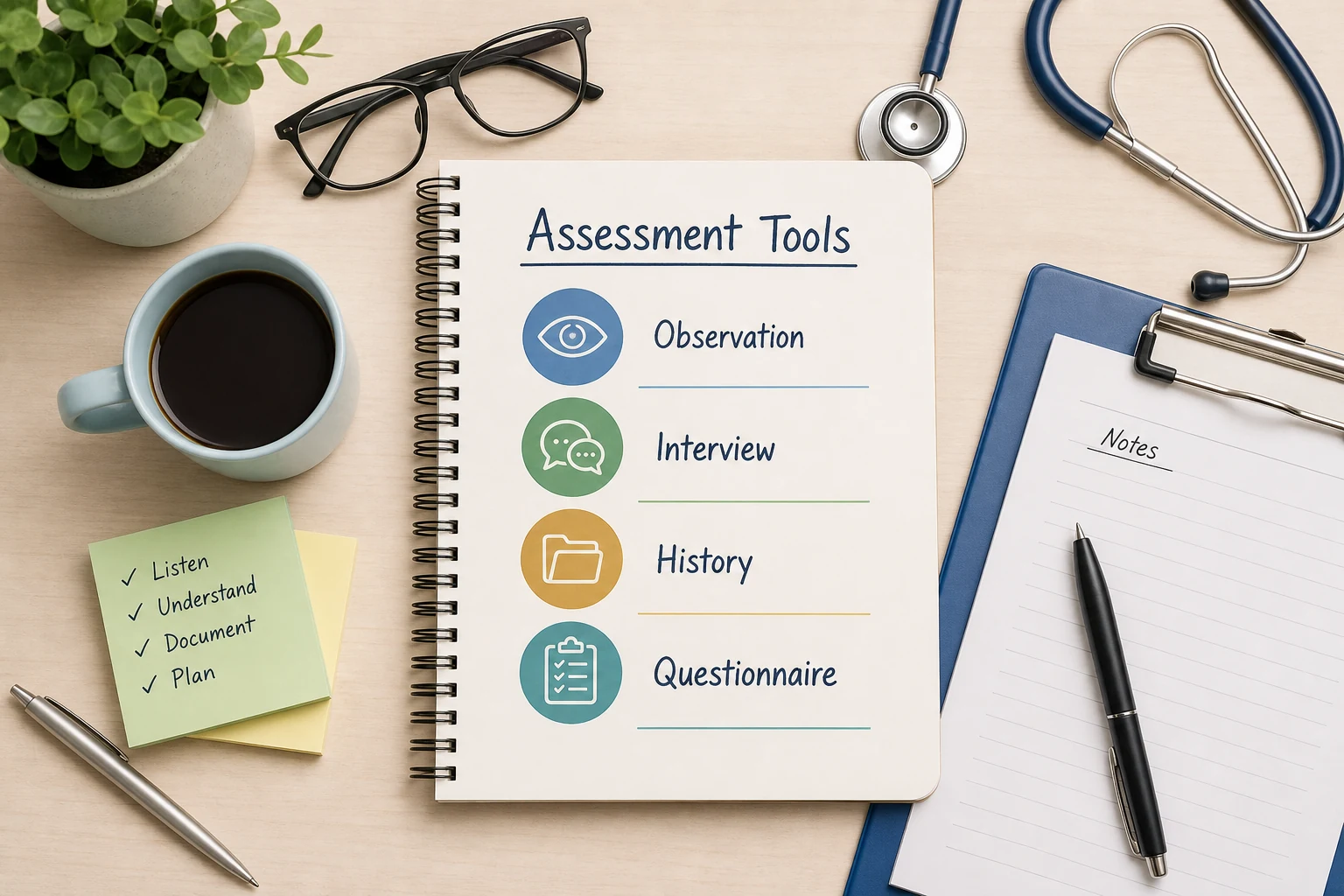
ADI-R stands for Autism Diagnostic Interview-Revised. It is a structured interview that focuses on developmental history, early social communication, repetitive behaviors, and patterns across time. In many assessments, this kind of history is important because autism is understood as a lifelong neurodevelopmental pattern, even when it becomes clearer only in adulthood.
For adults, developmental history can be complicated. Not everyone has access to childhood records. Some caregivers may not remember details clearly, may interpret events through outdated ideas, or may have missed traits because the person learned to compensate early. This is especially relevant for women, nonbinary people, and people who learned to blend in for safety or acceptance.
If you are preparing for an assessment, it may help to write down examples rather than trying to produce a perfect life story. Useful notes might include sensory sensitivities, social fatigue, special interests, routines, shutdowns, burnout periods, communication differences, friendship patterns, school reports, or situations where you copied others to understand what was expected. These notes do not need to prove anything. They simply help make your experiences easier to discuss.
RAADS-R, AQ, and Other Adult Screeners
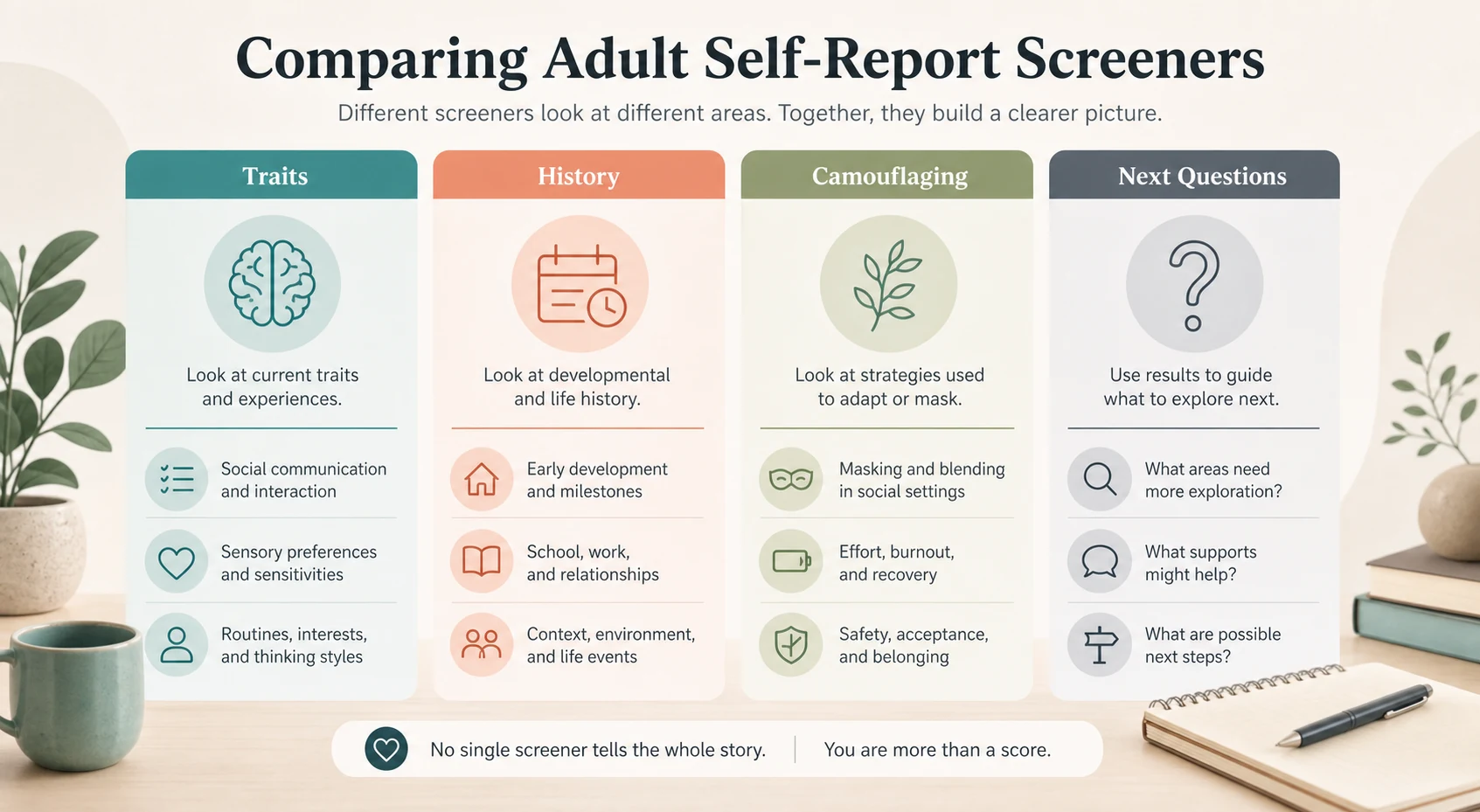
RAADS-R and AQ are two names adults often find when searching for an ASD test online. RAADS-R is an 80-item self-report screener designed for adults and often discussed in relation to late identification. AQ is a shorter questionnaire that measures autistic traits across several areas. Both can be useful for reflection, but neither should be treated as a standalone clinical result.
The value of these tools is pattern recognition. A questionnaire can reveal that several experiences cluster together: sensory discomfort, social confusion, intense interests, routine needs, literal interpretation, or long-term social exhaustion. It can also help someone decide what to bring up with a therapist, psychologist, physician, or assessment team.
The limitation is context. A questionnaire cannot ask follow-up questions, distinguish every overlapping condition, or understand why a person answered a certain way. Anxiety, ADHD, trauma, obsessive-compulsive traits, giftedness, chronic stress, and cultural expectations can all affect responses. That is why a responsible article about autism test names should always separate screening from clinical assessment.
Where CAT-Q Fits Among Autism Test Names
CAT-Q stands for Camouflaging Autistic Traits Questionnaire. It is a 25-item self-report questionnaire focused on autistic camouflaging: the strategies someone may use to hide, compensate for, or blend around autistic traits in social situations. CAT-Q does not ask the same question as ADOS-2, ADI-R, RAADS-R, or AQ. Instead of asking broadly about autistic traits, it asks about the effort of managing how those traits appear to others.
The CAT-Q is often especially relevant for adults who say things like, "People think I am fine, but social life costs me a lot," or "I can perform the expected behavior, but I feel exhausted afterward." Its three subscales are Compensation, Masking, and Assimilation. Compensation refers to learned strategies such as rehearsing conversations or studying social rules. Masking refers to hiding natural behaviors or reactions. Assimilation refers to pushing yourself to fit into social expectations even when it feels uncomfortable.
If your search for an autism test name is really about naming the hidden effort behind social performance, the CAT-Q camouflaging questionnaire may be more directly relevant than a broad trait screener. It can help you notice patterns, prepare language for a professional conversation, and reflect on whether masking is affecting energy, identity, relationships, or burnout risk.
A Practical Comparison of Names
Here is a simple way to sort the names without getting lost:
| Name | What it usually means | Typical role |
|---|---|---|
| ADOS-2 | Structured observation | Clinical assessment support |
| ADI-R | Structured developmental interview | Clinical history support |
| RAADS-R | Adult self-report autism screener | Personal reflection and assessment preparation |
| AQ | Autistic traits questionnaire | Broad trait screening |
| CAT-Q | Camouflaging and masking questionnaire | Understanding social masking patterns |
| ASD test | General search phrase | Could mean any of the above |
This table is deliberately cautious because names get used loosely online. A website may call a self-report questionnaire a test, while a clinician may reserve the word assessment for a broader professional process. Search engines also mix clinical tools, quizzes, screeners, blog posts, and paid services together. The best next step is to match the tool name to your actual question.
If your question is, "Could autism be worth exploring?" a general adult screener may help. If your question is, "Why do I look socially capable but feel depleted?" CAT-Q may be a better fit. If your question is, "Do I need formal recognition or accommodations?" then a qualified professional assessment is the relevant path.
What Are the Three Tests for Autism?
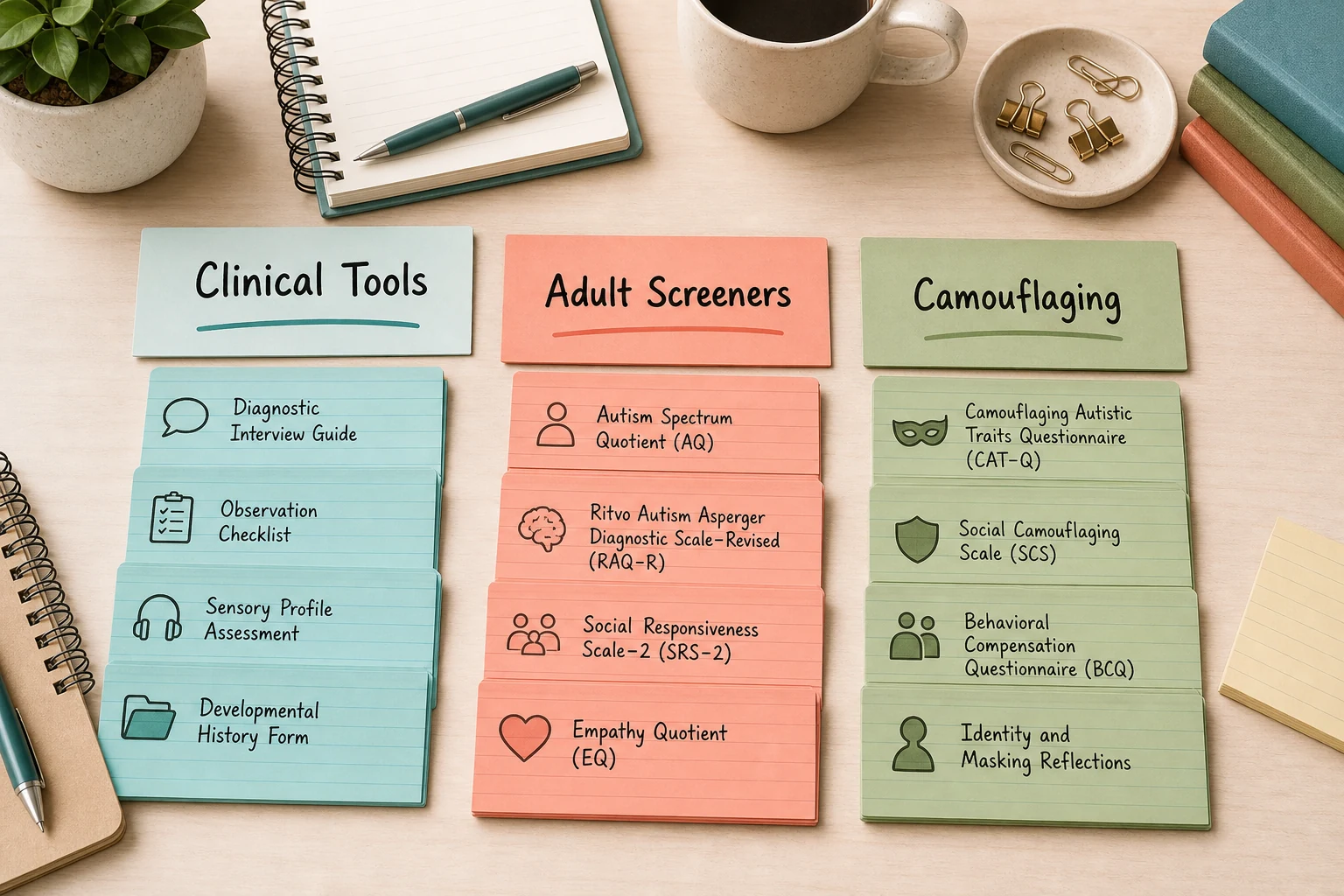
There is no official universal set of exactly three autism tests. However, people often group three categories together: observation tools, developmental interviews, and self-report questionnaires. ADOS-2 is the familiar observation name. ADI-R is the familiar structured interview name. Adult screeners such as RAADS-R, AQ, and CAT-Q may provide supporting information, depending on the person and the setting.
For children, additional tools may appear, such as CARS-2 or other developmental screeners. For adults, tools and interviews often need to account for a lifetime of adaptation, masking, mental health history, and uneven support. The exact tool mix depends on the clinician, country, age, communication profile, and reason for assessment.
Instead of looking for the "right three," it is more useful to ask whether the process covers three kinds of information: what can be observed now, what has been true over time, and what the person experiences internally. For high-camouflaging adults, that third category is essential because inner effort may be invisible in a short appointment.
What About the Four Types of Autism?
People still ask about the "4 types of autism" because older labels remain online. Historically, terms such as autistic disorder, Asperger syndrome, childhood disintegrative disorder, and pervasive developmental disorder not otherwise specified were used as separate categories in some systems. Today, many current clinical frameworks use autism spectrum disorder as the umbrella term and describe individual differences through support needs, language profile, intellectual development, sensory patterns, and co-occurring conditions.
This shift matters for searchers. If you are looking for an autism test name, older subtype names may lead you to outdated content or oversimplified explanations. Modern assessment is less about sorting people into neat subtypes and more about understanding a person's profile: strengths, support needs, communication, sensory processing, daily functioning, and mental health context.
It is also worth being careful with labels such as "high-functioning" or "mild." They can hide the cost of masking and make support needs less visible. A person may work, study, maintain relationships, and still experience intense exhaustion or shutdowns. CAT-Q-style reflection can be helpful here because it focuses on the effort behind outward appearance.
How to Choose the Next Name to Explore
The best autism test name to search next depends on the question you are trying to answer. If you want to understand clinical assessment language, search ADOS-2 and ADI-R. If you want an adult self-report starting point, search RAADS-R or AQ. If you want to understand masking, compensation, and the pressure to appear socially typical, explore CAT-Q.
Before using any questionnaire, set a low-pressure goal. You are not trying to force a result. You are collecting language for self-understanding. Afterward, write down what felt accurate, what felt unclear, and what did not fit. If the topic feels important for your wellbeing, accommodations, therapy, or identity, consider discussing your notes with a qualified professional who understands adult autism and neurodiversity.
For a private first step focused specifically on camouflaging, the private CAT-Q exploration tool can help you reflect on Compensation, Masking, and Assimilation without treating the result as a clinical endpoint. Use it as one piece of a larger picture: your history, your current needs, your relationships, your sensory world, and the support that may help you live with less constant performance.

FAQ
What is the test for autism called?
The best-known clinical observation tool is often called ADOS-2, short for Autism Diagnostic Observation Schedule, Second Edition. A full autism assessment may also include ADI-R, developmental history, questionnaires, interviews, and professional judgment. Online self-report tools such as RAADS-R, AQ, and CAT-Q serve a different purpose: they help people explore patterns and prepare questions.
What is the ADOS test for ASD?
ADOS-2 is a structured observation tool used by trained clinicians during autism assessments. It creates consistent opportunities to observe social communication, interaction, and certain behavior patterns. It is not meant to stand alone. It is usually interpreted alongside history, interviews, other measures, and clinical context.
What are the three tests for autism?
There is no single official trio. A common practical grouping is ADOS-2 for observation, ADI-R for developmental interview, and questionnaires such as RAADS-R, AQ, SRS-2, or CAT-Q for supporting information. The exact mix depends on age, setting, communication profile, and the professional completing the assessment.
What are the 4 types of autism?
Older content may list autistic disorder, Asperger syndrome, childhood disintegrative disorder, and PDD-NOS. Many current systems now use autism spectrum disorder as the broader category and describe individual profiles through support needs, language, intellectual development, sensory differences, and co-occurring conditions.
Is CAT-Q an autism test name?
CAT-Q is the name of a self-report questionnaire about camouflaging autistic traits. It is related to autism exploration, but its focus is narrower than a general ASD screener. It looks at Compensation, Masking, and Assimilation, which can be especially relevant for adults whose social effort is hidden.
Is RAADS-R the same as ADOS-2?
No. RAADS-R is a self-report questionnaire completed by the individual. ADOS-2 is a structured observation conducted by a trained clinician. They answer different kinds of questions and are used in different ways.
Can an online ASD test replace a professional assessment?
No. Online questionnaires can support reflection, but they cannot replace a careful professional assessment when clinical recognition, accommodations, or complex mental health questions are involved. Use online results as notes for a broader conversation, not as a final clinical answer.