Why CAT-Q Answers Can Change by Situation
Some CAT-Q questions feel easy to answer when you think about work, school, or public settings. The same questions can feel different in safer spaces. Many people answer one way for work and another way for their closest relationships.
That does not mean you answered the test wrong. It may mean your camouflaging changes with context. Many autistic adults do not camouflage at one fixed level all day, in every relationship, or in every room. They adapt more in some places and less in others.
A reflective CAT-Q self-assessment can still be useful when your answers feel uneven. In fact, that unevenness can be part of the pattern the tool is helping you notice.
Disclaimer: This article is for educational purposes only and should not replace professional medical advice, diagnosis, or treatment. The CAT-Q is a self-reflection and screening tool, not a diagnostic test for autism.

Why Camouflaging Is Often Context-Dependent
How the CAT-Q measures compensation, masking, and assimilation across lived behavior
The original CAT-Q paper describes the questionnaire as a 25-item self-report measure with 3 factors: Compensation, Masking, and Assimilation. It was developed using data from 832 autistic and non-autistic adults (PubMed CAT-Q development paper). That matters because the tool is not trying to capture one single behavior. It is looking at different ways people adapt socially.
Compensation can involve learning social rules or scripts. Masking can involve hiding behaviors that feel natural. Assimilation can involve pushing yourself to appear more socially typical, even when that costs energy. Those strategies do not always show up at the same intensity in every setting.
That is why an autistic camouflaging questionnaire may feel different depending on what examples come to mind while you answer. Work, family, dating, and close friendships can each pull different parts of the pattern into focus.
What research says about work, family, and social setting differences
Research supports that idea. A 2019 study of 262 autistic people examined camouflaging behaviors, contexts, reasons, and mental health symptoms. It found that both camouflaging highly across contexts and switching between camouflaging in some contexts but not others were linked to poorer mental health (PubMed camouflaging contexts study).
A qualitative study of 92 autistic adults found that people often camouflaged to fit in and connect with others. It also reported consequences such as exhaustion and threats to self-perception. Those details help explain why answers may shift between formal spaces, unsafe spaces, and safer relationships.
If you mask heavily at work but much less with a trusted friend, that does not cancel out the work pattern. It simply means context matters.
Why Changing by Situation Does Not Make the Result Meaningless
High camouflaging everywhere versus switching by context
Some people camouflage almost everywhere. Others switch hard depending on where they are. One person may compensate in nearly every conversation. Another may only do that in workplaces, medical settings, or unfamiliar groups.
The context study matters here because it does not say only one pattern counts. It suggests that both high camouflaging across many settings and switching between settings can carry a mental health cost. So if your answers feel variable, the result is not automatically weak or invalid. It may reflect the real way you move through different environments.
Why a lower answer at home can still fit a high-masking life
Many users worry that a lower answer in one safe setting somehow proves they are "not really masking." That is not how context works. If home is safer, quieter, or more predictable, you may need fewer camouflage strategies there.
A CAT-Q reflection tool is most useful when you answer with your broader life in mind. Ask yourself where you monitor tone, rehearse scripts, copy expressions, suppress natural behaviors, or recover afterward. A lower-answer environment can be just as informative as a high-answer environment because it shows where the pressure changes.
How to Use a CAT-Q Result When Your Masking Changes by Setting
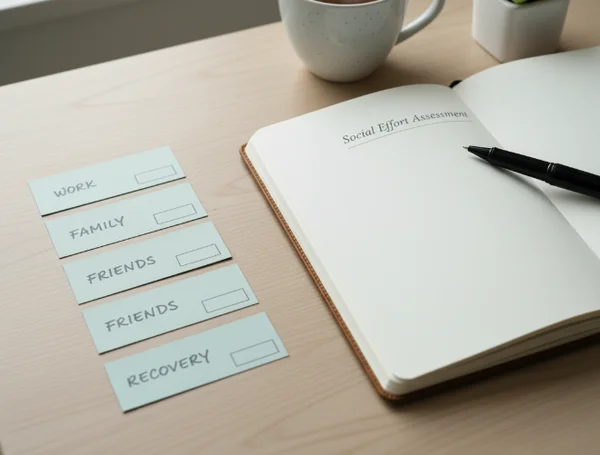
What to write down about work, friends, family, and recovery time
If the test felt inconsistent, that is a good reason to write notes rather than ignore the result. Break it down by setting. How much do you camouflage at work? With family? With strangers? With the people who feel safest? How tired do you feel afterward in each place?
This kind of note-taking can reveal more than one total score. You may notice that the hardest part is not every interaction. It may be one environment where you feel watched, corrected, rushed, or overloaded. That insight can make the result more useful in therapy, assessment, or support conversations.
When to seek support or urgent help
Seek support if camouflaging is leaving you exhausted, isolated, burned out, or unsure who you are allowed to be. If distress becomes severe, if you feel hopeless, or if you are thinking about harming yourself, seek immediate help. SAMHSA says the 988 Suicide and Crisis Lifeline offers 24-hour, toll-free, confidential support for people in distress (SAMHSA Helplines).
That reminder matters because a familiar CAT-Q result can bring relief. It can also bring grief, confusion, or burnout awareness. A supportive clinician or another qualified professional can help you sort through what belongs to masking, what belongs to stress, and what next step feels safe.

What to Remember If Your CAT-Q Answers Felt Inconsistent
Inconsistent does not always mean inaccurate. Sometimes it means your social survival strategies depend on who is in the room, how safe the setting feels, and how much energy you have available.
That is one reason the CAT-Q can still be helpful even when your answers feel mixed. It can show you where the effort is concentrated and where it loosens.
If your result felt uneven, treat that as data. Look for the settings that pull the most effort from you, notice what recovery costs follow, and bring that pattern into a supportive or professional conversation.