CATQ Scores Explained: Cutoffs, Ranges & What They Mean
You’ve just completed the Camouflaging Autistic Traits Questionnaire (CATQ), and now you’re looking at a set of numbers. It’s a common experience to feel a mix of curiosity and confusion. What do these scores actually mean for you?
Plenty of us have stared at those numbers feeling the same mix of 'huh?' and 'aha!'. Digging into your score? It's a game-changer for figuring yourself out. Let's unpack it together. We will break down the total score, explain the different subscales, and explore what these results might reveal about your life and experiences. If you haven't taken the test yet or want a fresh start, you can always take the free CATQ test on our platform.

Understanding Your Total CATQ Score: Ranges & Meanings
Your total score provides a snapshot of your overall camouflaging behaviors. It combines your answers across all 25 questions to give a single, comprehensive figure. But a number by itself is just data; its true value lies in its interpretation.
What is the CATQ Test? A Quick Refresher
Before we dive into the numbers, let's briefly recap what the CATQ is. The Camouflaging Autistic Traits Questionnaire (CATQ) is a scientifically validated self-report measure developed by Dr. Laura Hull and her colleagues in 2018. It was designed specifically to measure the extent to which adults camouflage, or hide, their autistic traits in social situations.
Many autistic people—especially women and late-diagnosed adults—camouflage to fit into a neurotypical world. It's a common strategy. The questionnaire helps quantify these often invisible efforts.
Decoding Your Total Score: Low, Average & High Thresholds
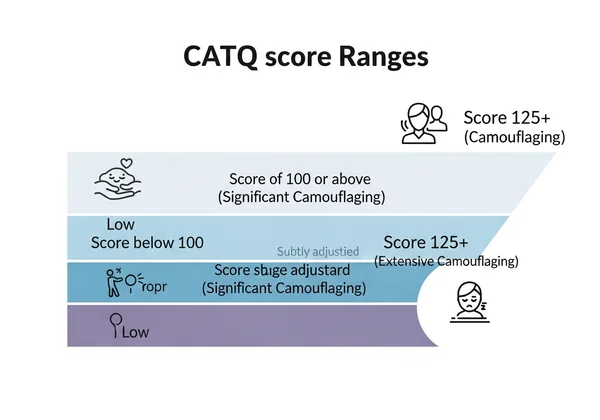
The CATQ is scored out of a total of 175. While every individual's experience is unique, the original research provides a helpful guideline for interpreting your total score. The most cited figure is the CATQ cutoff score of 100.
Here’s a general breakdown of what different score ranges might indicate:
- Score below 100: This range typically suggests a lower level of autistic camouflaging. You might use some social strategies, as many people do, but it may not be a constant or draining part of your daily life.
- Score of 100 or above: This is often considered the clinical cutoff. A score here signals significant camouflaging. You probably pour mental and emotional energy into masking traits, compensating for social hurdles, and blending into groups.
- Very High Score (e.g., 125+): Scores in this upper range point to extensive and potentially exhausting camouflaging efforts. This high level of masking can be linked to burnout, anxiety, and a feeling of being disconnected from your true self.
Remember, these are not rigid categories but guiding frameworks. The context of your life is just as important as the number itself.
Why Understanding Your Total Score Matters for Self-Insight
Your score might feel validating. For many, a high one explains years of feeling 'different' or wiped out after socializing. It's real—you've been working overtime to fit in.
This knowledge is the first step toward self-compassion. It allows you to acknowledge the energy you’ve been spending and begin exploring ways to live more authentically. If you'd like to get a more detailed analysis, you can understand your score with our unique AI-powered report.
Delving Deeper: CATQ Subscales & Their Thresholds
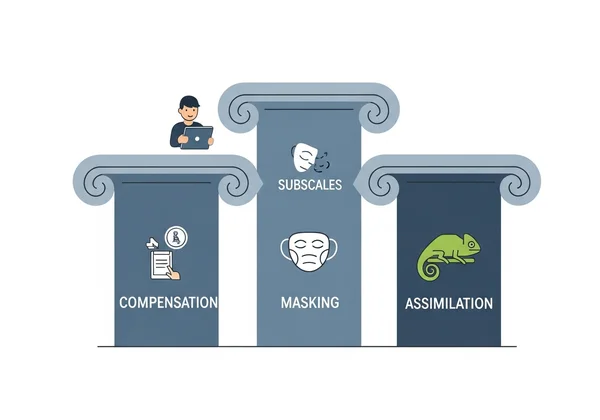
Your total score tells a big part of the story, but the three subscale scores reveal how you camouflage. The questionnaire breaks down camouflaging into three core pillars: Compensation, Masking, and Assimilation.
Compensation: Strategies to Appear Non-Autistic
Compensation refers to the strategies you use to actively overcome social difficulties. It's about learning and applying social rules intellectually, almost like studying for a test.
Examples include:
- Developing a script before a phone call.
- Intentionally using pre-practiced gestures or facial expressions.
- Copying the body language of others to seem engaged.
A high Compensation score suggests you are a skilled social analyst, constantly observing and implementing strategies to navigate conversations and interactions successfully.
Masking: Suppressing Autistic Traits in Social Settings
Masking is the process of hiding or suppressing natural autistic traits and behaviors. This is often an effort to avoid standing out or being judged by others.
Examples include:
- Forcing yourself to make eye contact even when it’s uncomfortable.
- Hiding your special interests to appear more "mainstream."
- Suppressing the urge to stim (e.g., hand-flapping, rocking).
A high Masking score indicates you spend significant energy monitoring and controlling your authentic self in social environments, which can be incredibly draining.
Assimilation: Blending In & Minimizing Differences
Assimilation is the effort to fit in with others and be seen as part of the group. This often involves putting on a persona or acting in a way that feels inauthentic just to be accepted.
Examples include:
- Pretending to be interested in a conversation you find boring.
- Staying at a loud party even when you feel overwhelmed.
- Forcing yourself to be more outgoing and talkative than you naturally are.
A high Assimilation score shows a drive to blend in. But it often costs your comfort and well-being.
Interpreting Subscale Scores: Patterns of Camouflaging
Looking at your three subscale scores together reveals your unique "camouflaging style." For instance:
- Someone with high Compensation and Masking but lower Assimilation might be very good at "performing" neurotypical behaviors but doesn't feel a strong need to be part of the group.
- Someone with a high Assimilation score might prioritize social belonging above all else, even if it means feeling completely exhausted afterward.
Understanding your personal pattern is key to identifying which behaviors are causing the most stress and where you might want to make changes.
Beyond the Numbers: What Your Score Reveals
Your results are more than just numbers on a screen. They are a gateway to understanding your lived experience, your challenges, and your strengths.
Common Reactions to a High Score
Seeing a high score for the first time can bring a wave of emotions. Many people report feeling:
- Relief: "Finally, there's a word for what I've been doing my whole life."
- Validation: "I'm not lazy or broken. I've been working twice as hard."
- Grief: Sadness for the years spent hiding their true self.
One person shared, "Seeing my score of 120 was a lightbulb moment. It finally explained why social events felt like running a marathon." This kind of insight is common and can be a huge relief. Every one of those emotions hits home for someone. Give yourself time to sit with it—no rush.
Connecting Scores to Daily Life: Fatigue, Anxiety & Identity
A high score often correlates directly with real-world challenges. Do any of these sound familiar?
- Social Burnout: Feeling completely drained after work, school, or social gatherings, needing hours or days to recover.
- Persistent Anxiety: A constant low-level fear of "getting it wrong" socially or being "found out."
- Identity Confusion: A sense of not knowing who you really are beneath the layers of masks and learned behaviors.
Recognizing that these struggles are linked to camouflaging can be the first step toward finding solutions. When you're ready, you can explore your results and see personalized insights connecting your scores to these exact life areas.

Important Disclaimer: CATQ is Not a Diagnosis
This is a crucial point to understand. This questionnaire is a powerful tool for self-exploration, but it is not a diagnostic tool for autism. A high score indicates significant camouflaging, which is common in autistic individuals, but it can also be present in people with social anxiety or other conditions.
Only a qualified healthcare professional can provide a formal autism diagnosis. You can use your results as a starting point for a conversation with a therapist or doctor, but please do not treat it as a self-diagnosis.
Your Next Steps: Embracing Self-Understanding with CATQ
Your score is not an endpoint; it's a signpost on your journey of self-discovery. It gives you a new language to describe your experiences and a new lens through which to view your past, present, and future.
Understanding your camouflaging behaviors is the first step toward choosing when to use these skills and when to let your authentic self shine. It’s about moving from unconscious survival to conscious choice.
Are you ready to dive deeper into what your unique scores mean? Start your assessment today and unlock our optional AI-powered report for personalized insights, actionable advice, and a clearer path toward a more authentic life.
Frequently Asked Questions About CATQ Scores
What is a high score on the CATQ?
Based on the original research by Hull et al. (2018), a total score of 100 or higher is generally considered a high score, indicating a significant level of camouflaging behavior.
What is the cut off score for the CATQ?
The most commonly referenced clinical cutoff score for the CATQ is 100. This threshold helps distinguish individuals who engage in significant camouflaging from those who do not.
How do I know if I'm masking autism based on my score?
A high score, particularly on the "Masking" subscale, strongly suggests you are actively suppressing autistic traits. While the CATQ doesn't diagnose autism, these results can be a powerful indicator that your experience aligns with that of many autistic people. To explore this further, you can take our online test and review your detailed subscale breakdown.
What is the difference between masking and camouflaging within the CATQ?
In the context of the CATQ, camouflaging is the overall umbrella term for all strategies used to hide autistic traits. Masking is one specific type of camouflaging, focusing on the direct suppression of autistic behaviors (like stimming). The other two types are Compensation (learning neurotypical behaviors) and Assimilation (trying to blend in).