CATQ Score: Your Next Steps After the Test
You've just completed the Camouflaging Autistic Traits Questionnaire (CAT-Q) and now you're holding a number—your CATQ score. Seeing that result can bring a wave of emotions. Perhaps it's a sense of validation, a moment of clarity, or maybe a feeling of confusion about what it all means. Whatever you're feeling, it's a perfectly normal part of this journey. You’ve taken a significant step toward self-discovery, but you might be wondering, How do I know if I'm masking autism? This guide is here to walk you through your results and empower you with clear, practical next steps.
Your score is not an endpoint; it's a signpost. It’s a piece of data that can help illuminate your path forward. Here on our platform, we believe in empowering you with tools for deeper self-awareness. Let’s explore what your score means and what you can do with this newfound insight. You can always revisit your journey and explore your results on our platform.

Understanding Your CATQ Score: What It Means
Receiving your score is the first step, but the real value lies in the CATQ score interpretation. This number is a quantitative measure of the camouflaging strategies you may be using in your daily life. It’s a reflection of the energy you expend to navigate social situations. Let's break it down into more manageable pieces to better understand the full picture.
Is Your CATQ Score 'High'? Understanding the Spectrum
One of the first questions people ask is whether their score is "high." The original research by Hull et al. (2018) suggests a total score of 100 or above indicates significant camouflaging. However, it’s crucial to see this not as a simple pass/fail line but as a point on a spectrum. A score below this threshold doesn't invalidate your experiences of social difficulty, just as a score above it doesn't automatically define you.
Think of it as a gauge of intensity. It helps quantify the extent to which you might be using strategies to manage social interactions. Understanding your level of camouflaging autistic traits is a powerful tool for recognizing patterns you may not have been aware of before.
Decoding the Sub-Scales: Compensation, Masking, & Assimilation
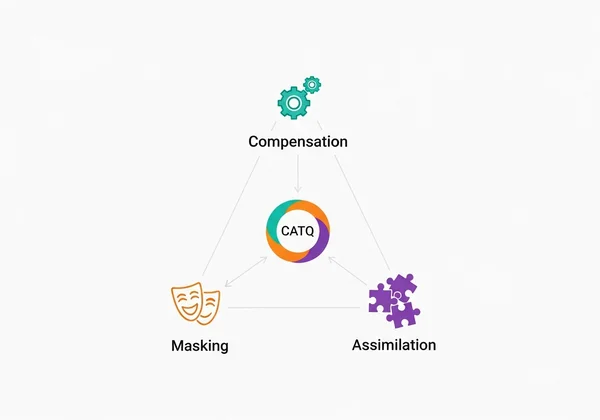
Your total score is comprised of three distinct sub-scales. Each one reveals a different facet of your social strategy, and understanding your unique blend of compensation, masking, and assimilation can be incredibly insightful.
- Compensation: This is the "learning" part of camouflaging. It involves developing strategies to overcome perceived difficulties in social situations. This could mean learning social rules from movies, creating mental scripts for conversations, or consciously imitating others' body language.
- Masking: This is the "hiding" element. It involves actively suppressing natural behaviors, like stimming (e.g., fidgeting, rocking), or forcing oneself to make eye contact even when it feels deeply uncomfortable. It's about hiding traits that you feel might be perceived as "odd."
- Assimilation: This is the "fitting in" component. It involves putting on a persona to feel accepted in a group. This can be incredibly draining, as you might act like someone you’re not, trying to blend in seamlessly with those around you.
Your personal report on the CAT-Q test platform breaks down these scores, showing you which strategies you might rely on most.
Beyond the Number: What Your CATQ Score Doesn't Tell You
Your score is a valuable piece of information, but it’s essential to maintain perspective. It is a snapshot, not your entire story. To truly honor your journey, you must recognize both the power and the limitations of this tool.
Why the CATQ Isn't a Diagnostic Tool
This is the single most important takeaway: the CAT-Q is a scientifically validated self-assessment tool, but it is not a medical diagnosis. It measures the degree of social camouflaging, which is common in many autistic individuals—especially in cases of undiagnosed autism in adults—but it can also be present for other reasons, such as social anxiety.
This test is designed for self-exploration and to provide you with a language to describe your experiences. It can be a fantastic starting point for a conversation with a qualified professional, but it cannot replace a comprehensive diagnostic evaluation.
The Importance of Your Unique Lived Experience
No questionnaire can ever fully capture the complexity of your lived experience. Your memories, feelings, challenges, and strengths are uniquely yours. Your CAT-Q score is a single thread in the rich tapestry of who you are.
Use this score as a lens to re-examine your past and understand your present. Does it help explain why social events leave you feeling exhausted? Does it resonate with that lifelong feeling of being slightly different? Let the score serve your understanding, not define your identity. To feel truly seen and validated, consider getting your AI insights for a more personalized report.
Your Next Steps After Taking the CATQ Test
So, you have your score and a better understanding of what it represents. Where do you go from here? Here are some actionable next steps after the test to continue your journey of self-discovery and well-being.
Step 1: Reflect and Journal Your Insights
Take some quiet time for yourself. Grab a notebook or open a document and just write. Don't worry about making it perfect; simply let your thoughts flow. This reflection is key to genuine self-understanding.
Consider these prompts:
-
Which questions on the test stood out to me the most? Why?
-
Can I think of specific examples in my life where I used compensation, masking, or assimilation?
-
How do I feel physically and emotionally after a day of heavy social interaction?
-
What would it feel like to let go of one small mask in a safe environment?

Step 2: Explore Further Resources & Community Support
You are not alone on this path. Many others share similar experiences. Seeking out neurodivergent communities online (like on Reddit or Facebook) can provide an incredible sense of belonging and validation. Hearing others' stories can help you feel less isolated and provide practical tips for navigating the world more authentically.
Our platform is also designed to be a hub of information. We encourage you to explore our resources for more articles and insights into autistic camouflaging.
Step 3: Considering Professional Consultation
If your results have brought up significant questions or distress, or if you wish to explore a formal diagnosis, seeking professional consultation is a logical and supportive next step. A therapist, psychologist, or psychiatrist specializing in adult autism and neurodiversity can provide a comprehensive assessment and guide you toward personalized support strategies. Bring your CAT-Q results with you; it can be a great conversation starter.
Embracing Authenticity: Moving Towards Unmasking
Understanding your camouflaging behaviors through an autistic masking test is the first step toward living a more authentic life. The ultimate goal is not to stop all social strategies but to move from unconscious, draining camouflaging to conscious, intentional choices that honor your energy and well-being.

Starting Small: Practical Tips for Reducing Camouflaging
The idea of unmasking can feel overwhelming and even scary. The key is to start small, in safe spaces, and with safe people. You don't have to change everything overnight.
Consider trying one of these:
- Allow yourself a natural stim (like tapping your fingers or a leg jiggle) during a non-critical meeting.
- Decline a social invitation without giving an elaborate excuse, simply because you don't have the energy.
- Share a special interest with a trusted friend, even if you think it's "weird."
Managing Burnout: Prioritizing Your Well-being
One of the most severe consequences of long-term, high-level camouflaging is autistic burnout. This profound state of exhaustion—physical, mental, and emotional—comes from the chronic stress of trying to be someone you're not. Recognizing your masking behaviors is a critical step in preventing and recovering from burnout. By reducing the energy you spend on camouflaging, you free up that energy for rest, joy, and living authentically.
Your CATQ Journey: A Step Towards Greater Self-Understanding
Your CAT-Q score is more than just a number. It’s a key that can unlock a deeper understanding of yourself, explaining years of hidden struggles and celebrating the resilience you've shown. It’s an invitation to be kinder to yourself, to honor your needs, and to begin the journey toward a life with less performance and more presence.
This is your journey, and you are in control. Use this knowledge as a foundation to build a more authentic and fulfilling life. If you're ready to delve even deeper, consider exploring the optional AI Personalized Report available at CAT-Q.org, which provides detailed insights based on your unique answers.
Frequently Asked Questions About Your CATQ Score
What is a high score on the CATQ?
A score of 100 or more is generally considered to indicate a high level of autistic camouflaging, based on the original scientific research. However, any score that resonates with your personal experience is valid and worth exploring.
What is the cut-off score for the CATQ?
While 100 is used as a research-based threshold, there is no official "cut-off" for diagnosis. The CAT-Q is not a diagnostic tool but a measure of camouflaging behaviors. The score helps you understand the intensity of these behaviors in your own life.
How accurate is the CATQ test?
The CAT-Q is a scientifically validated and reliable questionnaire designed specifically to measure camouflaging in adults. Its accuracy lies in quantifying these specific behaviors. It does not, however, definitively diagnose autism.
Can I be autistic and not know it?
Absolutely. Many autistic adults, particularly women and individuals assigned female at birth, go undiagnosed because their high camouflaging abilities mask the more traditionally recognized autistic traits. Discovering this later in life is a very common experience.
How do I know if I'm masking autism?
Feeling perpetually exhausted after socializing, meticulously planning conversations beforehand, suppressing strong urges to fidget, or feeling like you're "acting" in social situations are all common signs of masking. A tool like the CAT-Q can help quantify these feelings. To explore your own traits, you can take the free test on our website.